
 By: Stephanie Allen-Gobert
Ethiopia (as it is known now), is a story of victory and piety that begins in ancient Abyssinia. This remarkable saint later became a spiritual guide to his fellow Africans. Several images throughout the week will be presented as part of The Root in conjunction with the image of the Black in Western Art Archive at Harvard University’s W.E.B. DuBois Research Institute, as part of the Hutchins Center for African and African American Research. The paintings are an outstanding example of Portuguese devotional art of the 18th century.
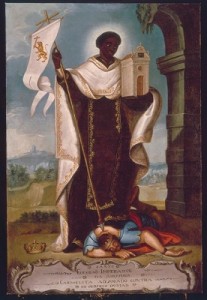
In this painting, Ethiopia is wearing the habit of the Carmelite religious order and holds a miniature church. The inscription at the bottom declares his special role as a protector against “the dangers of the sea.”
The story of St. Elesbaan goes back to the early period of Christianity’s long presence in Ethiopia. According to accounts, the man who would become St. Elesbaan ruled Axum during the first half of the sixth century. His given name was Kaleb, and he took the throne name Ella Atsbeha.
Also depicted is the black virgin saint Ephigenia. Ephigenia was the daughter of the king of Nubia. The dedicated Ephigenia founded a convent and, like Elesbaan, overcame great resistance to the faith, thereby ushering in a period of prosperity under Christian rule.
The real story of the veneration of Elesbaan occurs with the arrival of black Africans, mostly as slaves, first in Spain and Portugal in the 15th century, then in their New World colonies. To aid in the process of spiritual assimilation among the captives, religious confraternities of blacks, both free and enslaved, came to be established. Elesabaan joined the ranks as a powerful advocate of the ever greater number of slaves arriving from Africa during the 18th century.
The devotion of saints took hold in Brazil and other regions in the New World; becoming a force for the forming of black identity and empowerment. The organization began very modest, with group of blacks from a local parish meeting in a private home. The primary objective among members and the organization was the purchase of freedom for enslaved members. The confraternity served as a unique advocate for an oppressed population.
Like other brotherhoods, the organization was organized into seven distinct groups, or empires, defined in terms of their putative origins along the slave coast of Africa and other points of the slave trade, including east Africa. Each empire was ruled by its own king and queen, who were always of free status, thus introducing a hierarchy of power and influence with the brotherhood/fraternity.
The church founded in 1754 still survives, though its role has changed considerably with the abolition of slavery in 1888. With the lack of need in intervention of the brotherhood for their freedom, many ex-slaves left to seek their fortunes elsewhere. However, the saints Elesbaan and Ephigenia still maintain their relevance. These great African saints, “the two pillars of Ethiopia” as styled by Santana, are just as relevant now for advocacy for the welfare and future prosperity of the devotees.
Source: www.theroot.com
